What is Ken Kinna Charge on Credit Card?

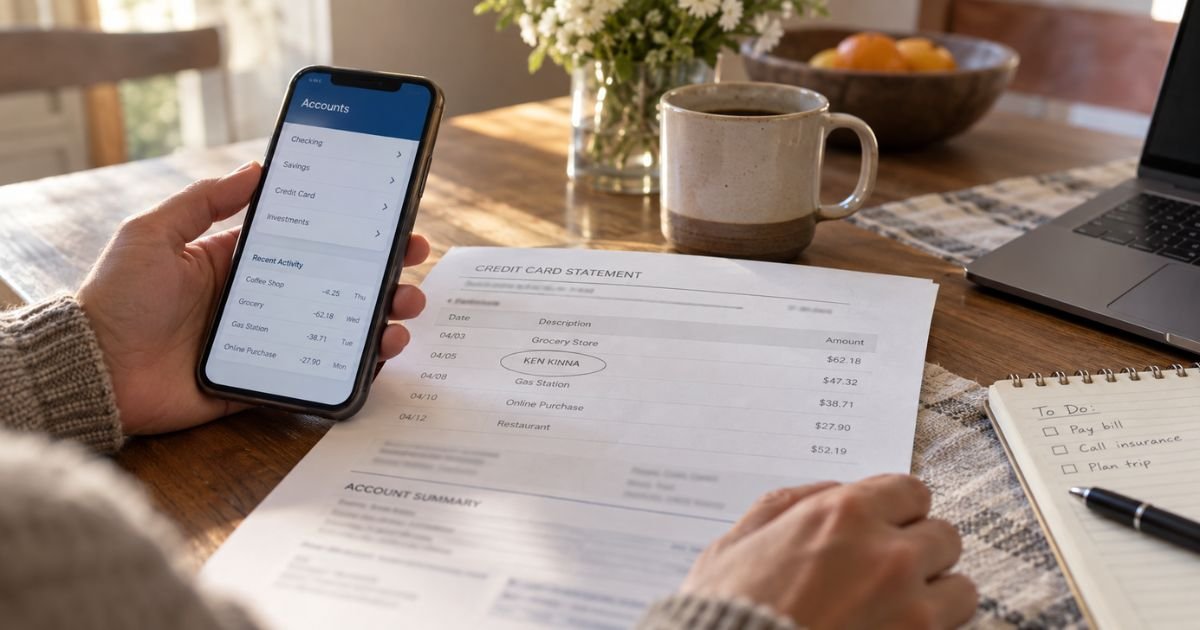
A Ken Kinna charge on credit card can feel confusing if you don’t recall signing up for anything. Unfamiliar names on a statement are often legitimate billing labels, not proof that someone stole your card. This guide shows what that line typically means, which lookalike names to check, and what to do next.
What a Ken Kinna charge on credit card usually is
A Ken Kinna charge on credit card is generally a merchant descriptor. That is the short name a seller, processor, or bank prints next to a payment. Card networks typically allow only about 22 characters, so names get cut, misspelled, or swapped for a legal entity.
Public records and consumer charge directories do not show a widely known U.S. retailer or subscription brand that bills exactly as “Ken Kinna.” Treat that wording as unidentified until you match the date and amount to a purchase you made. Do not assume fraud on the name alone. Do not assume it is safe either.
Your issuer may also add prefixes such as POS, CHKCARD, PENDING, or a city code. Those tags describe how the payment processed. They are not the store’s public brand.
Why the wording looks so odd
Merchants often bill under a DBA name, parent company, or payment processor instead of the storefront you remember. A local shop, an online checkout, or a marketplace seller can all show a name you never saw on a receipt.
Truncation is common. “KEEN INC,” “KEEN.COM,” or a longer legal name can appear as something close to Ken Kinna after a bank shortens the text. A typing error at the processor can do the same thing. You generally cannot confirm the source from the label alone.
If the line includes a phone string or a city, write those details down. Your issuer can often pull the merchant of record with that extra text.
Names that can look similar
These are lookalikes, not proof that your charge came from them. Match the date, amount, and card before you contact anyone.
| Wording you may see | What it can relate to | How to check |
|---|---|---|
| KEEN INC, POS KEEN, CHECKCARD KEEN | KEEN footwear and gear sold online or in stores | Search email for keenfootwear.com orders or a store receipt |
| INGENIO KEEN.COM or Keen | Keen.com advisor sessions billed by Ingenio | Sign in at Keen.com and open Transaction Details |
| KEN + extra letters, codes, or a city | A shortened DBA, processor, or local business | Ask your issuer for the merchant name and MCC |
| PAYPAL*, SQ*, or STRIPE* plus a name | A platform sale, not a standalone “Ken Kinna” brand | Open that platform’s purchase history for the same day |
Keen.com’s own help page says card charges typically appear as “INGENIO KEEN.COM.” PayPal charges on that site typically appear as “Keen.” If your line is only “Ken Kinna,” it may still be a different seller.
KEEN the shoe brand is a separate company. Shoppers generally see KEEN INC or a store name, not “Ken Kinna.” If you bought hiking shoes, sandals, or socks recently, start there.
How to verify the charge on your statement
Start with facts on the statement. Note the posted date, the exact amount, the last four digits of the card, and every word in the descriptor. Pending charges can change or drop off. Wait until a charge posts before you treat the amount as final.
Then match that row to your own records. Check email receipts, texts, wallet apps, and household calendars for the same day. Ask anyone who is an authorized user. A family purchase is a common reason a name looks new to you.
Open your card app and tap the transaction. Many issuers show a merchant category, city, or phone field that the paper statement hides. Search the web for the exact string in quotes. Skip ads that offer a “refund hotline.” Use official issuer chat or the number on the back of your card instead.
If you use several cards, confirm which one was billed. A small test charge on one card and a larger sale on another can look like two mystery payments.
What to do if you still do not recognize it
Call the number on the back of your card first. Ask the issuer to identify the merchant of record. Request the city, the merchant category code, and whether the sale was card-present or online. Keep a short note of the date, the agent’s name, and what they said.
If the issuer points to a real seller you used, contact that seller through a number or site you find yourself. Do not call a number printed only on a pop-up ad. Ask for an itemized receipt. Request a refund only if the purchase was a duplicate, a billing error, or a service you already canceled in writing.
If nobody in your household authorized the sale, treat it as unauthorized. Ask the issuer to block the card and send a replacement. Then send a written billing-error notice. The CFPB says you generally must get that written notice to the issuer within 60 calendar days after the statement that first showed the charge. Call first, then follow up in writing so the federal clock starts.
During a timely written credit card dispute, you typically do not have to pay the disputed amount while the issuer investigates. The issuer generally must acknowledge the notice within 30 days unless it already fixed the bill. It generally must finish within two billing cycles, and not later than 90 days. Outcomes still vary by issuer and by the facts.
File a complaint at reportfraud.ftc.gov if the charge looks like a scam. You can also use consumerfinance.gov/complaint if the issuer process stalls. Those sites do not replace the dispute with your bank.
How to stop a charge that might renew
A one-time sale will not keep billing you after you replace the card. A stored card on a site can. Search your email for “Ken,” “Keen,” “Ingenio,” “membership,” “autoship,” or “renewal” around the charge date.
If you find a Keen.com account, sign in and review Payment Information and Transaction Details. Keen.com lists 1-800-ASK-KEEN (1-800-275-5336) for balance and funding questions. Confirm any unused balance and ask support, in writing, to stop stored-card billing if you no longer want the service.
If you find a KEEN footwear order, use the order email or the returns portal on keenfootwear.com. A product charge is usually a single sale. A second charge can be a replacement pair, tax, or shipping, not a hidden club.
If you cannot find any account, replacing the card is still the cleanest way to cut a stored number. Update cards only on sites you still use. Watch the next two statements for a retry under a slightly different name.
Set purchase alerts in your card app. A $1 or $2 authorization is sometimes a merchant test. Report that pattern the same day if you did not start a checkout.
FAQs On Ken Kinna Charge on Credit Card
Q: Is a Ken Kinna charge on credit card always fraud?
A: No. The name is uncommon, so it is easy to misread. It can still be a real purchase billed under a shortened or mistyped descriptor. Match the date and amount first. Dispute it if you cannot tie it to anything you or an authorized user approved.
Q: Could this be Keen.com or KEEN shoes?
A: It might be, but only if the date and amount line up. Keen.com typically bills as INGENIO KEEN.COM on cards. KEEN footwear often shows as KEEN INC or a store name. “Ken Kinna” by itself is not a verified official descriptor for either brand.
Q: How long do I have to dispute the charge?
A: Call as soon as you see it. For federal credit card billing-error rights, the CFPB says your written notice generally must reach the issuer within 60 days after the statement that first listed the charge. Missing that window can weaken those protections. Issuer goodwill policies may still help, but they are not guaranteed.
Q: Will my bank automatically refund it?
A: Not automatically. Credit cards generally offer strong unauthorized-use protection, but you still have to report the problem and complete the issuer’s process. Keep screenshots, emails, and the statement page. Do not promise yourself a timeline the bank has not given you in writing.
Conclusion
A Ken Kinna charge on credit card is usually an unidentified billing label, not a famous brand name you should recognize at a glance.
Check receipts, authorized users, and lookalike descriptors such as KEEN INC or INGENIO KEEN.COM before you panic. If the sale still does not belong to you, call your issuer, replace the card, and send a written dispute on time.
Disclaimer: This article is for general information only. It is not financial, legal, or tax advice. Card network rules, merchant policies, and issuer procedures vary. Confirm any charge, refund, or cancellation with the company that billed you and with the bank that issued your card.