Calculate Finance Charge on Credit Card: Steps

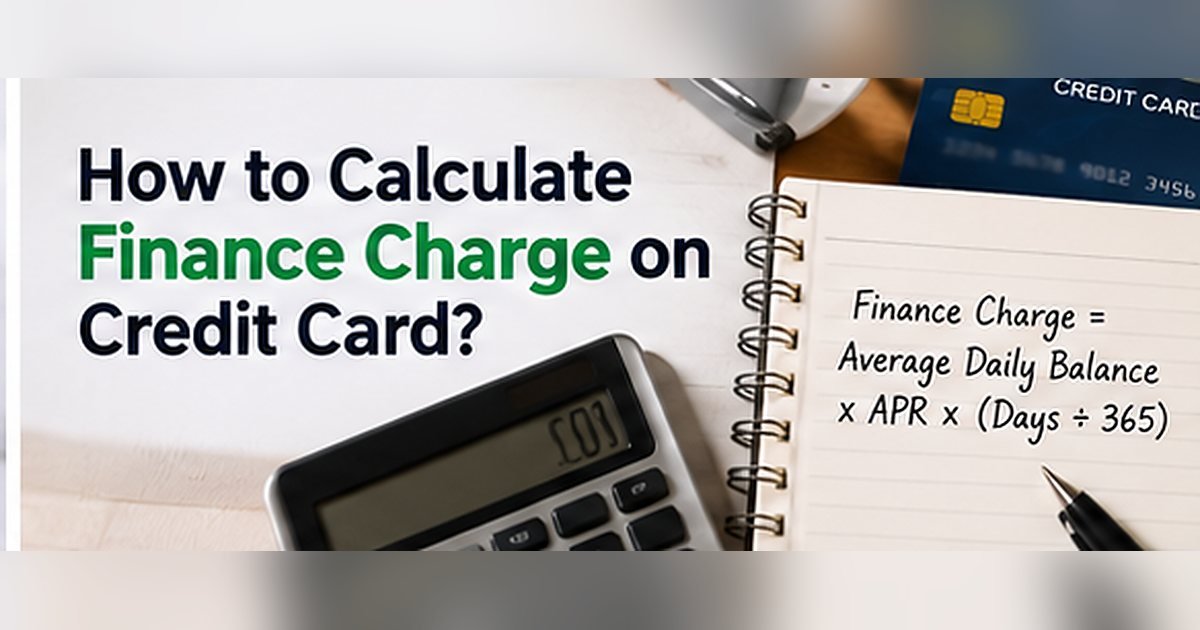
Learning how to calculate finance charge on credit card balances can help you understand a statement that seems unexpectedly expensive. In many cases, the finance charge is primarily interest, although the exact treatment of fees and balances depends on your agreement.
If the entry does not make sense at first glance, you do not need to guess. Verify the amount, the billing history, and the rules that apply to your account before taking action.
How to Calculate Finance Charge on Credit Card
For a simple estimate, start with the annual percentage rate, divide it by 365 to estimate the daily periodic rate, and apply that rate to the interest-bearing balance for each day in the billing cycle; our finance charge explainer covers the broader term. Add the daily amounts for the period. This simplified method will not always match your issuer’s detailed compounding and balance rules.
A useful shortcut for an unchanged balance is average daily balance times APR divided by 365 times days in the cycle. Use APR as a decimal, so 24% becomes 0.24. Consult the issuer’s actual terms before comparing your result against a statement.
Step 1: Find the right APR
Review the interest charge calculation table on your statement. Your card might show 19.99% for purchases and a higher rate for cash advances, with a different rate for a promotional balance. Each category must generally be calculated separately when the rates differ.
Do not use the penalty APR unless it actually applies to the relevant balance. Also check whether your purchase grace period eliminates interest on a category. An APR listed in the agreement does not automatically mean interest accrued on every purchase.
Step 2: Convert the APR into a daily rate
Divide the APR expressed as a decimal by the divisor stated in your card agreement. For example, 24% divided by 365 equals approximately 0.0006575 per day. That is about 0.06575% of an applicable balance each day.
Some card terms use a 360-day basis or account for daily compounding, so use the disclosed calculation method. Round only at the end when possible. Rounding the daily rate too early can cause a noticeable difference when you multiply by a larger balance.
Step 3: Track the changing daily balance
Record the balance for each day of the cycle after payments and eligible transactions are applied. Add the daily balances and divide by the number of days to find the average daily balance. If you have 15 days at $1,000 and 15 days at $700, the simple 30-day average is $850.
For a rough estimate, multiply that $850 by 0.24, divide by 365, and multiply by 30. The result is about $16.77 in interest before any issuer-specific compounding or other charges. A constant $1,000 balance over those same 30 days would yield about $19.73 by the same shortcut.
Step 4: Check whether the example matches your statement
Compare your calculation with the interest portion in the statement, not the entire sum of new purchases and fees. The issuer may compound interest daily or apply rules that change the balance used for interest. Transaction posting times also matter.
If your result differs by several dollars, check whether you included a cash advance, balance transfer, or newly posted payment in the right category. Review whether trailing interest continued after a payoff. Then ask your issuer for a calculation breakdown if the difference remains unclear.
A table of common calculation mistakes
Mixing up 24% and 0.24 makes a result one hundred times too large. Applying the purchase rate to a cash-advance balance can make the answer too small. Using the statement closing balance instead of an average daily balance can also miss important changes.
Another mistake is assuming every calendar month has 30 days. Billing cycles are based on the actual statement dates. Small differences from compounding or rounding may be expected, but never dismiss a large unexplained charge without checking the agreement.
What a finance charge may include
People sometimes use finance charge as a broad phrase for the cost of borrowing, which can include certain fees under applicable rules and disclosures. A card statement often separates interest charges from transaction fees. Determine exactly which line you are trying to calculate before using a formula.
A balance-transfer fee is not calculated the same way as daily purchase interest. An annual fee is also different from interest on an unpaid purchase balance. The simple interest formula should not be used to predict every amount charged by a card issuer.
Locate the rate and balance on your statement
Find the section usually labeled interest charge calculation. It may list purchases, balance transfers, and cash advances separately, each with its own annual percentage rate and balance subject to interest. Do not apply one purchase APR to every balance on the account.
Also find the billing-cycle closing date, payment due date, statement balance, current balance, and any promotional terms. These numbers serve different purposes. The statement balance is the amount billed at closing, while the current balance may change after the cycle ends.
Understand the grace period
Many cards provide a purchase grace period when you meet their conditions, commonly paying the statement balance in full by the due date. When a grace period applies, new purchases can avoid interest. Cash advances often have no comparable grace period, and their rates or fees may be higher.
If you have carried a balance, you may continue to owe residual or trailing interest after making a payment. Interest can accrue between the statement closing date and the day your payment is credited. Ask your issuer for the precise payoff amount if you are trying to bring the account to zero.
Know why daily balances matter
Issuers commonly use an average daily balance or daily balance method. Payments reduce the balance used in the interest calculation once they are credited, while new transactions can increase it. This means the timing of a payment can matter even when two people pay the same total by the end of a month.
Your card agreement explains its actual calculation method and whether interest compounds. Some simplified examples use APR divided by 365, but the card may disclose a different divisor or special rules. Treat any online estimate as an approximation until it matches your contract.
Separate interest from other charges
A statement may show interest charges near annual fees, late fees, balance-transfer fees, or cash-advance fees. They do not all arise for the same reason. A low balance is not a guarantee of zero charges if your agreement includes a minimum interest amount and interest would otherwise be due.
Read the statement line descriptions carefully. A payment that looks too small to affect your interest may still lower future interest by reducing principal. Likewise, making only the required minimum generally costs more over time than paying an additional amount toward the balance.
Protect yourself from calculation mistakes
Check whether you copied the APR as a percentage or a decimal. For example, a 24% APR is 0.24 in a formula, not 24. Make sure the number of days corresponds to the actual billing cycle and that payments occur on the dates used in your calculation.
Compare estimated interest with the next statement and investigate meaningful differences. New purchases, cash advances, compounding, fees, and varying daily balances can all change the result. Contact the issuer for the detailed method rather than treating a simple calculator as the final bill.
Example of the effect of paying earlier
Imagine a $1,000 interest-bearing purchase balance and a 24% APR for a simple illustration. At an assumed 365-day divisor, the daily rate is about 0.0658%, or roughly 66 cents per day on an unchanged $1,000 balance. Actual figures vary with balance changes and your issuer’s calculation.
A $200 payment made earlier in the cycle can reduce later daily interest compared with waiting to make that same payment. This does not mean that every card uses identical compounding or that your final charge can be computed from one average. Your account agreement governs.
How to discuss a surprise amount with the bank
Ask the issuer which balance category generated the charge, which APR applied, and the daily-balance period used. If there is a minimum interest provision, request the specific disclosure that explains it. Keep notes about the representative’s explanation and check it against the statement.
When you think a posted interest amount is a true billing error, use the issuer’s billing-error process rather than assuming the amount will vanish. Preserve your rights with timely written notice when applicable. Continue paying the undisputed portion of the account as required.
Official sources and further reading
CFPB: How issuers calculate interest; CFPB: Daily periodic rates; CFPB: Card contract definitions. Review the original sources for current procedures, and use the card issuer’s own agreement for account-specific terms.
FAQs On Calculate Finance
Q: What is the simplest credit card finance charge formula?
A: A common estimate is average daily balance times APR as a decimal divided by 365 times days in the cycle. Issuer rules can differ.
Q: How much interest on $1,000 at 24% APR for 30 days?
A: A simple constant-balance estimate is about $19.73 using a 365-day divisor, excluding compounding and other fees.
Q: Why is my actual finance charge higher?
A: Multiple APRs, cash advances, changes in balances, compounding, minimum interest rules, or fees may explain the difference.
Q: Can I avoid a purchase finance charge?
A: Often, yes, if your purchase grace period applies and you pay the required full statement balance by the due date.
Conclusion
To calculate finance charge on credit card balances, use the correct APR and the balances outstanding on each day of the billing cycle. A daily-rate estimate is useful for planning, while your card agreement and issuer’s calculation remain authoritative.
Disclaimer: This article is for general information only and is not financial or legal advice. Policies and billing practices vary by issuer and provider. Verify account-specific questions with the company and your credit card issuer.