What is LawDistrict Charge on Credit Card Statement?

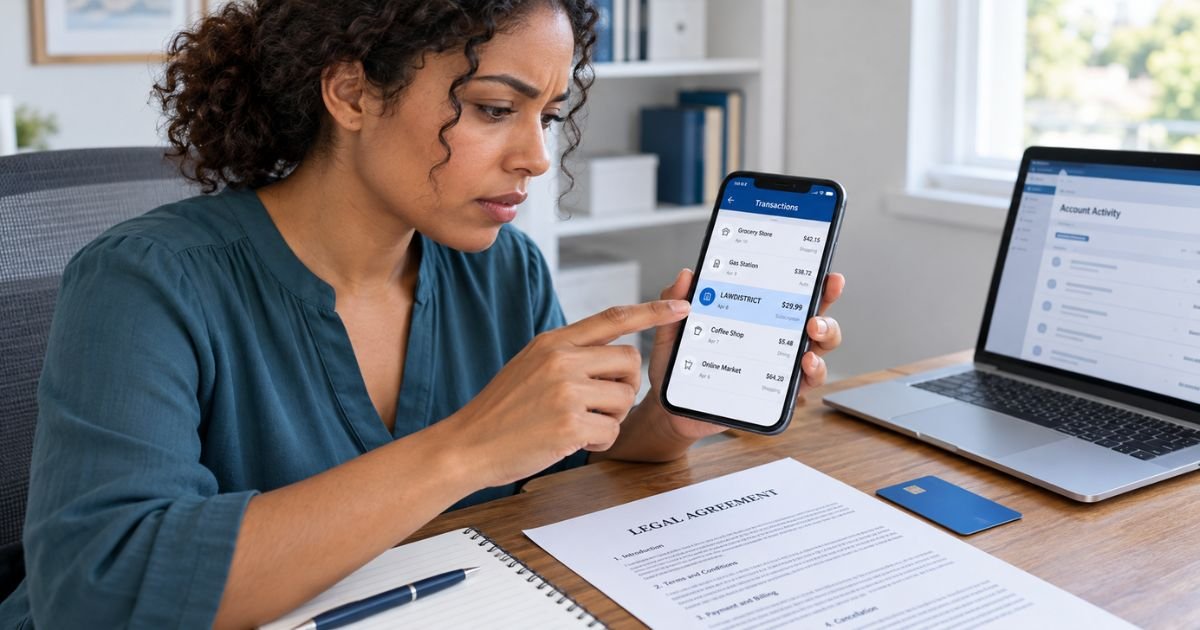
A LawDistrict charge on credit card statements can feel confusing if you don’t remember signing up for a legal document service. The charge typically comes from LawDistrict, an online platform that helps customers create and download legal forms, agreements, and contracts.
The good news is that many unfamiliar LawDistrict charges are legitimate subscription payments. This guide explains why LawDistrict may be charging you, how its trial works, and how to cancel or dispute unwanted payments.
What Is the LawDistrict Charge on Credit Card?
A LawDistrict charge on credit card statements generally represents a payment to LawDistrict, an online legal document creation service.
The platform allows individuals and businesses to prepare customizable legal documents without drafting everything from scratch.
Common documents include rental agreements, wills, powers of attorney, employment contracts, and business agreements.
LawDistrict offers free legal templates and paid subscriptions for additional document customization and downloads.
If you previously created a legal document through the platform, you may have signed up for a paid access plan.
A common reason for unexpected charges is LawDistrict’s automatic subscription renewal after its seven-day introductory offer.
However, the merchant name alone doesn’t prove that you authorized the transaction. You should verify the payment through your LawDistrict account or credit card issuer.
Why Is LawDistrict Charging My Credit Card?
Several situations may explain why a LawDistrict payment appears on your statement.
1. You purchased a legal document
If you created a lease agreement, will, or another legal form, you may have paid for access to LawDistrict’s document editing tools.
2. Your seven-day trial expired
LawDistrict offers a seven-day introductory subscription. If you don’t cancel before the trial ends, the membership generally converts into a recurring paid plan.
3. Your subscription renewed automatically
LawDistrict may continue charging your saved payment method while your paid membership remains active.
4. You forgot about an earlier purchase
You may have used LawDistrict to prepare a document several weeks or months ago. The resulting subscription could still be active.
5. Someone else used your card
A family member or another authorized user may have purchased access using your payment information.
6. The transaction is unauthorized
If you never used LawDistrict and nobody recognizes the payment, contact your credit card issuer to investigate possible unauthorized activity.
How Much Does LawDistrict Usually Charge?
LawDistrict offers different subscription options for accessing its legal document tools.
Its published U.S. pricing includes:
| Plan | Advertised price | Billing frequency |
|---|---|---|
| Free Access | $0 | Free features |
| 7-Day Access | $1.95 | Initial seven days |
| Continued Access | $39.90 | Every four weeks after the trial |
| Premium Access | $45.90 | Monthly |
These are advertised U.S. prices and may change depending on promotions or subscription terms.
If you see a $1.95 LawDistrict charge, it may represent the seven-day introductory offer.
A $39.90 charge may indicate that your introductory subscription converted into recurring paid access.
The standard access plan renews every four weeks, which isn’t exactly the same as a calendar month.
Check your account’s billing page to confirm your actual subscription price and next renewal date.
How Does LawDistrict Appear on Credit Card Statements?
LawDistrict confirms that its billing descriptor may vary based on the payment method and transaction details.
Possible descriptions include:
| Statement description | Possible meaning |
|---|---|
| LAWDISTRICT | LawDistrict subscription payment |
| LAWDISTRICT followed by digits | LawDistrict billing identifier |
| LWDISTRICT | Abbreviated LawDistrict merchant name |
| LADISTRICT | Alternate LawDistrict merchant identifier |
| LAWISTRICT | Alternate LawDistrict billing format |
| LAWDSTRICT | Shortened merchant description |
LawDistrict lists these and other descriptor variations in its published billing information.
Some descriptions include additional digits. These may be part of the merchant identification information rather than your order number.
If the transaction description resembles LawDistrict, check your account before assuming that it’s a different company.
Why Did LawDistrict Charge Me After a $1.95 Payment?
One common source of confusion is LawDistrict’s seven-day introductory subscription.
The company advertises access to customizable legal documents for $1.95 during the first seven days.
However, this introductory payment isn’t necessarily a one-time document purchase.
If you keep the subscription active beyond the seven-day period, LawDistrict generally charges the regular membership price.
For its standard plan, that means $39.90 every four weeks after the trial.
For example, you might pay $1.95 to download a rental agreement and later notice a $39.90 charge.
That later payment may be your first regular subscription renewal.
If you intended to make only one purchase, review the subscription terms and cancel any membership you no longer need.
How to Verify a LawDistrict Charge on Your Credit Card
If you don’t recognize the transaction, start by reviewing your billing records.
Step 1: Check the transaction details
Open your credit card app and review the full merchant description, amount, and payment date.
Step 2: Search your email
Search for LawDistrict, legal document, subscription confirmation, and payment receipt.
Look for messages sent around the date of your initial purchase.
Step 3: Sign in to LawDistrict
Open the official LawDistrict website and sign in using the email address associated with your purchase.
Step 4: Review your billing settings
Open your account’s Billing section.
Check your subscription plan, renewal date, and payment information.
Step 5: Check your document history
Review your account dashboard for agreements or legal forms you created.
Step 6: Contact LawDistrict support
If you can’t identify the charge, contact LawDistrict’s official customer service team.
Its published U.S. contact details include:
- Customer service: 855-997-0206
- Email: info@lawdistrict.com
- Published support hours: Daily, 9 a.m. to 9 p.m. Eastern Time
Ask the company to identify the payment and explain your active subscription status.
How to Cancel a LawDistrict Subscription
If you no longer need LawDistrict’s services, you can generally cancel your subscription through your account.
Follow these steps:
- Sign in to your LawDistrict account.
- Open your account dashboard.
- Navigate to the Billing section.
- Find your active subscription.
- Select the cancellation option.
- Complete the cancellation process.
- Save the cancellation confirmation.
LawDistrict states that subscription changes generally take effect from your next billing date.
Before canceling, download any completed legal documents you want to keep. Paid document access may end when your membership expires.
If you cannot access your account or locate the cancellation option, contact customer support.
Canceling your subscription generally prevents future renewals, but doesn’t automatically reverse previous payments.
Can You Get a Refund for a LawDistrict Charge?
You may be able to request a refund, depending on your account history and the circumstances of the payment.
For example, you might request a billing review if you were charged twice, canceled before renewal, or didn’t authorize the subscription.
Contact LawDistrict customer support and explain the issue.
Provide the transaction date, amount, and any cancellation confirmation.
Ask whether the payment qualifies for a refund under the terms that applied when you subscribed.
LawDistrict doesn’t guarantee that every subscription renewal will be refunded.
If the company cannot resolve an incorrect charge, contact your credit card issuer to discuss your dispute options.
Is the LawDistrict Credit Card Charge a Scam?
A LawDistrict charge isn’t automatically fraudulent. LawDistrict is an identifiable online service that provides customizable legal documents.
However, some customers report surprise recurring payments after purchasing low-cost introductory access.
This doesn’t automatically mean the transaction was fraudulent. It may mean the customer didn’t realize the introductory offer included automatic renewal.
You should still investigate payments that don’t match your account history.
If you’ve never used LawDistrict, cannot locate a matching membership, or notice unauthorized transactions, contact your credit card issuer promptly.
How to Dispute an Unauthorized LawDistrict Charge
If you believe the transaction is unauthorized or incorrectly billed, your card issuer can help investigate.
Follow these steps:
- Contact your credit card issuer using the number on the back of your card.
- Report the unfamiliar LawDistrict transaction.
- Provide the amount, date, and merchant description.
- Explain why you believe the payment is incorrect.
- Submit any supporting receipts or cancellation records.
- Follow your issuer’s dispute instructions.
For qualifying U.S. credit card billing errors, you generally must send written notice within 60 days after your issuer sent the first statement containing the error.
Your bank may investigate and issue temporary credit during the process.
A final refund depends on the investigation and applicable consumer protections.
How to Prevent Future LawDistrict Charges
You can reduce unexpected payments by reviewing subscription terms before entering your credit card details.
Pay close attention to introductory offers that automatically convert into paid memberships.
If you need only one legal document, check whether the service requires a continuing subscription.
Set a reminder before your trial expires and save your cancellation confirmation.
Enable transaction alerts through your banking app so you can identify recurring payments quickly.
Remember that replacing your credit card may not automatically cancel an existing subscription.
FAQs On LawDistrict Charge on Credit Card
Q: What company is LawDistrict on my credit card statement?
A: LawDistrict is an online legal document creation platform. A charge generally represents paid access to customizable legal forms, contracts, or an automatically renewing subscription.
Q: Why did LawDistrict charge me $39.90?
A: A $39.90 charge may represent the regular subscription payment after LawDistrict’s seven-day introductory offer. The standard plan generally renews every four weeks unless canceled.
Q: How do I stop LawDistrict from charging my credit card?
A: Sign in to your LawDistrict account, open the Billing section, and cancel your active membership. If you cannot complete cancellation online, contact LawDistrict customer support.
Q: Can I get a refund from LawDistrict?
A: You can request a refund through LawDistrict customer support. Approval depends on your subscription terms and billing circumstances. If the charge was unauthorized, contact your credit card issuer promptly.
Conclusion
A LawDistrict charge on credit card statements usually comes from a paid legal document subscription. It may represent a $1.95 introductory offer, a $39.90 recurring membership payment, or another authorized plan.
If you don’t recognize the charge, review your LawDistrict account and billing history. Cancel unwanted subscriptions before renewal, contact customer support about refund eligibility, and report unauthorized payments to your credit card issuer.
Disclaimer: This article is for informational purposes only and does not provide financial or legal advice. Subscription prices, cancellation terms, refund eligibility, and credit card dispute procedures may vary by company and issuer. Verify account-specific questions directly with LawDistrict or your bank.